


It’s likely that nobody sat down and intentionally built the church model you are leading right now.
Here’s how most models are built. Or should we say “evolve.”
A staff member left, so someone absorbed the role. A ministry started because a volunteer had energy for it. A service element got added for Easter and stayed on the calendar for good. A tradition began as an experiment and calcified into an expectation.
Basically, you inherited a series of decisions nobody remembers making. That pattern shows up in almost every church over five years old.
The Model You’re Running Isn’t the One You’d Choose
Ask yourself something uncomfortable. We’ll keep this between you and me. If you were starting your church today, knowing what you now know about your community, your team, and your mission, would you build what you currently have?
Most pastors go quiet at that question.
The honest answer is usually no. At least not in totality.
Every piece of the current model made sense in isolation. Nobody ever evaluated the whole system, so the whole system never got the chance to be chosen.
How the Model Actually Formed
A hundred reasonable decisions build this, each one made under pressure and never revisited. Rarely does one bad call do the damage. The damage comes from a hundred small patches nobody circled back to fix properly.
A staffing gap gets patched instead of redesigned. A program survives because canceling it costs more energy than keeping it running. A Sunday element stays because removing it upsets someone, and upsetting people costs more attention than leaving the calendar alone.
Every decision maker was managing that week. Nobody was managing the whole system.
Here’s a lesson we all need to remember: Structure precedes growth. When leaders don’t choose the structure on purpose, growth builds itself around whatever already exists, and what already exists was never evaluated against where you’re actually trying to go.
Why Nobody Notices the Gap
Of course, an unexamined model doesn’t feel chaotic. It feels calm, predictable, familiar.
The calendar runs itself. Staff know their lanes. Nobody asks hard questions because nothing looks broken on the surface.
Even if it doesn’t make sense, it makes sense.
A church running on intention and a church running on inertia can look identical on a Sunday morning. You can’t tell the difference by studying the org chart. You can only tell by asking why each piece exists.
Run the Audit Most Pastors Skip
Most pastors will optimize a program before they’ll question whether the program should exist. That instinct protects whatever’s already running instead of testing it.
If you really want to do an audit, before your next staff meeting, list every recurring program, role, and tradition currently running in your church. Next to each one, write down who decided to start it, and why.
You’ll land in three categories:
- Things someone chose deliberately, for a reason that still holds
- Things someone chose deliberately, for a reason that no longer applies
- Things nobody chose. They just started, and stayed.
That third category is your real model. Your actual, operating architecture, the one that runs your church’s time and attention regardless of what the mission statement on your website claims.
Most churches are running a strategy they never agreed to.
Run It This Week
- Pick one ministry area to audit first: staffing, Sunday programming, or your discipleship pathway. Choose whichever one creates the most quiet friction right now.
- List every recurring program, role, or tradition inside that one area, and write down who decided to start it and why.
- Sort each item into one of the three categories above. Don’t fix anything yet. Just name what you find.
- Bring the list to your next leadership meeting and ask one question out loud: which of these would we choose again, on purpose, if we were starting today?
If You Don’t Run The Audit…
Nothing dramatic happens if you skip this. That’s exactly the problem.
Without an audit, the pattern continues. Next year’s model gets built on top of this year’s, the same way this year’s was built on last year’s. One more patch. One more inherited assumption. One more program nobody chose, but everybody keeps running.
Five years from now you could be leading a church shaped by accidental moments instead of intention. Staff will burn out serving structures nobody will defend. Volunteers will quietly disengage from ministries that stopped making sense years ago. When you finally try to redesign, you won’t know where to start, because nobody tracked what was chosen and what simply happened.
Skipping this audit doesn’t cause collapse. It causes a church that runs fine and leads nowhere.
To some extent, you didn’t build the model you’re currently running. You inherited it one reasonable decision at a time. The only question left is whether you keep inheriting it, or finally decide.
One More Thing…
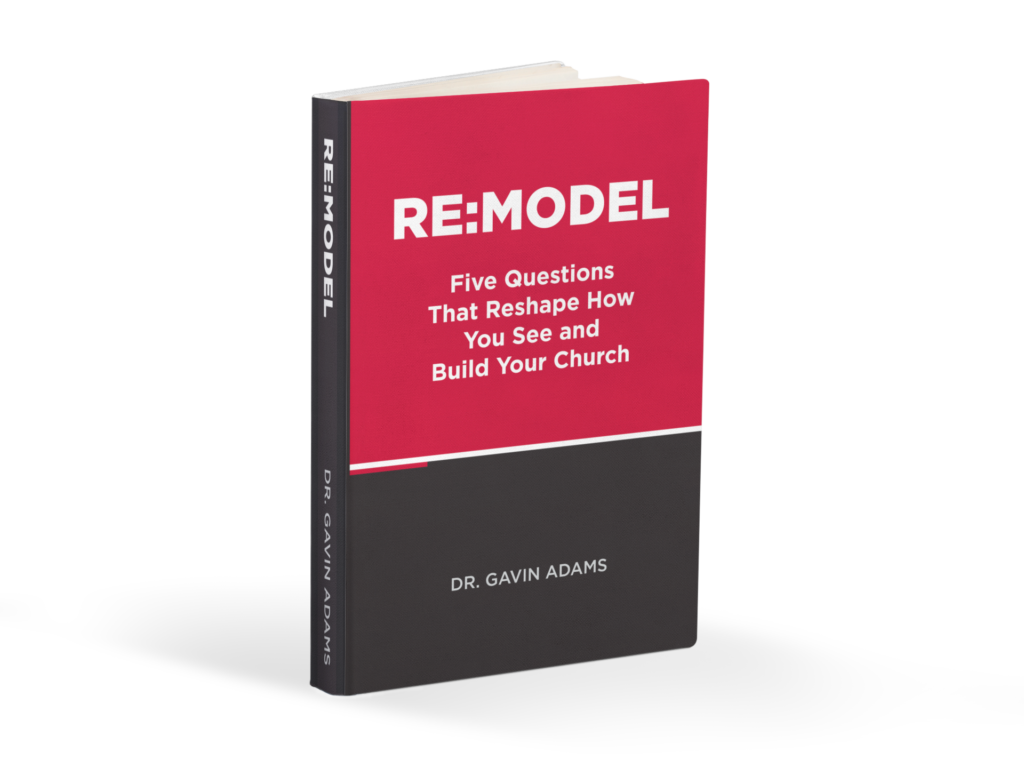
If this conversation resonates, you should definitely join me and some like-minded pastors at my next Think Tank. On September 8 at 1:00 PM EST, I am leading a conversation from my newest book, RE:MODEL, FIVE QUESTIONS THAT RESHAPE HOW YOU SEE AND BUILD YOUR CHURCH.
Register for the Think Tank today. And if you’re interested in the book, check out more here.
Quotes to Share
- “You didn’t build this church. You inherited it one reasonable decision at a time.”
- “A church running on intention and a church running on inertia can look identical on a Sunday morning.”
- “Most churches are running a strategy they never agreed to.”
Helping You Add More Intention To Your Mission,
Dr. Gavin Adams